Tuesday, December 13, 2022

Why Multifamilies Will Be The Best Investment On The Planet in 2023

Apartment Building Art as if by Thams Kincade
Did I "make it" if I used DiffusionBee to render the image?

As a real estate entrepreneur, I've purchased 11 properties: some multifamily rentals, a couple of single-family homes, a storage facility, warehouses, and land.

I started in 2009 and could not have timed the market better. And we accelerated our growth by finding poor-condition properties and improving them (known as a value-add deal). And after purchasing $4 million worth of real estate as a solopreneur, I'm transitioning our business model because of three major trends.


Economic Headwinds

We are in uncertain economic times (duh). The efforts of central planning to counteract free market trends are no longer enough to keep the boom going, and now our government's focus is on minimizing the crash.


Despite those efforts, experts I follow - Robert KiyosakiHarry DentPeter SchiffGeorge Gammon, and Michael Burry (and others) - all think housing prices will drop significantly. Even as much as 50% in 2023! My experience has been they usually get the magnitudes right, but the transition takes longer because of central planning offsets.


Looking at housing price drivers - income, inflation, mortgage rates, yield curves, T & bond markets, demographics, and unemployment - they point to a highly volatile real estate market in the next few years.


In general, when housing suffers, this increases the demand for rentals. Plus, larger rentals are valued differently than single-family homes (multifamilies are basically a mini-business and valued as such), so their values tend not to drop as much as long as rents don't fall. (1)


Also, volatility creates opportunities.


Housing Demand

The demand for smaller housing is driven by a few factors:

  1. People are having fewer kids and having them later in life, so they don't need as much space.
  2. People are choosing to spend their income on clothes, food, and experiences.
  3. We are now an "asset light" generation, where everything is becoming a subscription. We no longer need to buy and store DVDs, books, or cars - we can, and increasingly do, rent them.
  4. The minimum construction cost per square foot has increased because of increased code requirements and building costs. This pushes builders and flippers upmarket - a principle described in The Innovator's Dilemma. The logic goes like this: "Doing the minimum work is already expensive, so we might as well install the highest quality possible to earn the highest margins." This makes new and recently remodeled homes less affordable.
  5. Plus, in my opinion, tiny homes are awesome! :)


I see this anecdotally with my rentals. My studios and 1-bedrooms rent significantly faster than my 2 or 3-bedroom places.


Technology Automation

The real estate industry is notorious for slowly adopting technological changes. In 2005, being a DIY landlord became much easier because of Youtube. Suddenly, I could watch someone do a repair, and I felt empowered to tackle it myself.


Docusign started in 2003, but it wasn't until 2013 that agents began using it. Also, in 2013, online rent payments became much more straightforward - and free! - with sites like Cozy (now owned by CoStar Group), but that also took a few years to gain traction.


2020 normalized doing everything online. Now I don't meet tenants face-to-face until I hand them their keys (and I only meet my storage tenants if there's a problem).


And today, those simple online payment websites are complete management suites. Not only do they handle all tenant interactions, but they also help passive investors track their investments. These platforms focused on automating and standardizing routine tasks. Today, many of them are starting to leverage AI models to aid decision-making (like predicting maintenance needs). What used to require a small team can be done by a single part-time person leveraged by technology.


What It Means

Inflation, and central planning efforts to control it, will put downward pressure on real estate prices. Again, we'll likely see significant drops in real estate prices (not every market, but many) and even more falls in the stock market. This will probably ruin millions of baby boomers' retirement plans.


But it won't last forever.


Eventually, Fed Chairman Jerome Powell will win his war on inflation, and as we're starting to see, rates will come back down. It won't happen immediately, given the other economic issues, but it will help housing prices rise again. And they'll be at higher inflation-adjusted prices.


Meanwhile, demand for apartments continues to grow, which raises rents. Plus, inflation raises rents. Meanwhile, the cost of managing real estate assets continues to fall. Maintenance and utility costs are increasing, but the overall net effect on the net operating income (NOI) is higher margins.


The value of a multifamily property is determined by a multiplier of the net operating income (NOI). (2) And interest rates are starting to push the multiplier down. So, despite the increasing NOI (which would increase the value of a property), property values are staying the same and starting to decrease.


Large multifamily price drops likely won't be anywhere near 50%, but they will create an exciting buying opportunity over the next few years.


Multifamily Syndication

Instead of buying properties using only our funds, we're opening up our business for other investors to partner with us. By pooling our resources, we can purchase apartment buildings that would be difficult or impossible to buy on our own.


We, the General Partners, will organize the syndication: find the property, secure financing, and manage the property. Others, the Limited Partners, will provide the cash and receive an equity share along with cash flow distributions and profits in return for their investment.


I believe multifamilies are the best investment on the planet because of their consistent above-average returns (10%+), extraordinary tax benefits, inflation hedge, and creative financing. And it's providing something that everyone needs: housing.


So we're excited to open up multifamily investing to people who don't have the time or knowledge to pursue it on their own. We already have a few people interested in joining us, and we're open to more. It'll be a win for us, investors looking to diversify from the stock market, residents looking for a nice place to live, and communities with quality, safe housing.


We've revamped our website as well: https://furlo.com.


I don't have a place under contract yet, but over the next year, you'll hear more about what we're up to (read: you'll see more activity on social media). I'll also be sharing updates and insights via email.


One interesting wrinkle of syndications is that they use private securities. According to the SEC's Rule 506(b), we must have a prior relationship before inviting someone to invest in a specific property. So, if you're even a little interested, let's chat. I can show an example deal and share more about our investment philosophy. We can also talk about your goals. Then, when we get a property under contract, you can decide if you want to participate.


It's an exciting time!


---

(1) There's more nuance, of course, but that's a longer conversation, which I love having! Ping me. :)


(2) Technically, it's divided by a percent, called the Capitalization Rate, but I find it easier to think in terms of a multiplier, like the PE-Ratio with stocks.

Monday, September 05, 2022

Invest In What You Love


I recently heard 
a quote by Robert Kiyosaki that resonated with me. I usually harp on the benefits of pursuing assets instead of pursuing a higher-paying job. We've tried to spend our job income on buying assets, and then we used the income from our assets for spending. It didn't happen instantly, but it was a multi-year transition. For example, we only got a dog after our rental income increased enough to support one. Same with vacations and a bigger house. Eventually, all of our living expenses were paid for by our assets. At that point, my job became optional. I could have kept working if I wanted, but I had the option to quit.


(Side note: if you can get a higher-paying job without giving up too much time if your life, go for it. But, lock in your living expenses and use the surplus to buy cash-flowing assets.)


But that's focusing on assets to pay for your living expenses. This new-to-me quote looks at assets from the lens of work. Here it is:


"Invest in what you love rather than do what you love."


This quote is a little different than the classic platitudes:

  • "Choose a job you love, and you will never have to work a day in your life."
  • "Do what you love, and the money will follow."


So, how do you invest in what you love? You buy assets that let you do that thing. For example: 

  • Do you love teeth? Don't just study to become a dentist. Start a dentist's practice where you hire other dentists. You can also do dentistry, but you don't have to. And when you retire, you can also sell the business.
  • Are you into data science? Don't just work for a large tech firm; start a consulting firm side hustle. The tools you build are assets, and so is your client list. Or, as I did, use your skills to identify hidden gems. I focused on real estate, but you can do the same with businesses, paper, or commodities.
  • Do you love art? Don't just throw pots; buy a share of an art studio co-op. (OK. This may not actually be an asset, which I define as something that puts money in your pocket, but still.)


So, you might start by working a job doing what your love, but that's just the beginning of the journey. Use that job for discovery, development, and saving capital to invest. And then, as that passion deepens and your wealth grows, invest in what you love by buying/creating related assets. Not only does it let you go deeper on that thing you love, but if it's a cash-flowing asset, it might make the job optional in the future.


And yes, that might mean investing in specialized education to go even deeper. For example, I just signed up for a 6-month intense mentor program to teach me how to syndicate apartment buildings. The education itself isn't an asset, but the skill I learn and the network I build will be an asset if I use them.


What I'm suggesting is more complicated than only practicing your craft in a job, but I think the long-term rewards are worth it.


Real Life Example

I listened to a BiggerPockets podcast with Tim Delany, where instead of taking another job, he invested in a liquor store with almost zero technological improvements: no point of sale system, no running inventory, and a cash register that was appropriate for the 1950s, not the 2020s. With the right upgrades, he turned it into a full-fledged business with multiple employees and hundreds of thousands in profit.


It let him do the things he loved: run a social media channel, figure out how to optimize inventory, experiment with new technology, and eventually set his own hours.


One thing I find fascinating is that he made the same amount of money as his old job for a while. But, he was also building an asset. So today, he makes more than his old job while working far fewer hours. That feed him up to pursue additional passions.


It turns out that many small businesses are coming up for sale as Baby Boomers retire. And many of them have similar opportunities to improve sales and operations. Furthermore, Tim Delany pointed out that buying a business doesn't take as much capital as you think because you can also get seller and/or SBA financing. He purchased his business for ~$350K but only put in $50K cash. He received a note from the seller for $50K and an SBA loan for $250K. In the first year, the business did $600K in sales with a little under $80K profit.


And I know some people who buy businesses and partner with smart people to run them. They're still involved - because they love it - but not in the daily operations. To make it work, they usually split some of the equity with the people actively managing the business, which keeps both of their goals aligned.


So that's how you invest in what you love. Again, it's not as easy as only focusing on your craft, but there are tremendous benefits. Mostly, investing in assets gives you options in the future.


Saturday, June 04, 2022

You Need A Council

Group Council Meeting
Photo by Chase Chappell on Unsplash


This last quarter I interviewed a handful of business owners & leaders to understand better how they handle challenging situations and decisions. I wanted to know if there was an opportunity to create a monthly gathering to help them take their life and business to the next level from a Christian perspective. I embarked on this mini-journey because I had many causal exchanges last year with business owners and sensed a need. I also found myself in a comfortable place and wondering how to take my business to the next level.

The conversations were fascinating, and I appreciated how quickly everyone opened up to me. Actually, I was surprised by how much people shared! They dove almost immediately into their most pressing issues, and I could sense a small weight lifted from simply sharing their problems with someone else.


I came away with two conclusions.


1) Problems Are Industry Specific

There are some overlapping leadership issues, but all of them are heavily influenced by their industry. So, there are some common issues like motivating people, increasing sales, managing cash flow, improving operations, and long-term planning. But the specifics and tactics tend to shift within different industries. So, this group would either need to stay tightly focused on one sector or stay general.


2) Problems Mostly Stem From Discipline, not a Lack of Knowledge

There are lots of resources already available: coaches, mastermind groups, clubs, podcasts, videos, email newsletters, and more! The problem isn't learning how to run a great organization because the information is available. The problem is a lack of accountability to keep pushing on the right things. There are, of course, advanced tactics that could be helpful, but most people merely need to stay disciplined with the basics.


So, instead of creating a monthly meeting... one more reason to "play business" and not get real work done, I thought I'd share the one thing I noticed successful people do.


Create a Council

I was re-reading Good to Great when the pieces came together. Jim Collins notes that becoming great doesn't happen overnight; it's a process; a messy process. And one way to help you find your path is by regularly gathering a group of people to help you think through important issues. It doesn't need to be an official board of directors, but a group of committed people.


Who Should Create a Council?

If you sell things, create things, or lead people, you will benefit from a council. If you have something important you're working on, you will benefit from a council.


I'm thinking of business owners, managers, missionaries, parents, artists, entrepreneurs, and many more.


When I turned 36, my body changed, and my weight started slowly increasing. I could no longer eat whatever I wanted, but I didn't have good eating habits to lean on. I looked forward ten years - when my kids would be the most active - and I didn't like my chances of keeping up. My health became important to me. So, I hired a coach to help me get fit. And it worked! There's something to the wisdom that professionals hire coaches.


You could hire a coach, but I think you would get just as much value, if not more, from a council.


You could also do a mastermind-style group that overlaps on the important thing. It's the same idea as below, but everyone gets a turn in the hot seat.


Who Should Join Your Council?

You want at least 3 people, but 12 is overkill. I feel like 5 is perfect, allowing one or two people to miss and still have a productive session.


You aren't looking for specific skills, though some industry/business knowledge will help, and if you know someone already where you want to be, fantastic! Look for people you trust who are creative problem solvers, willing to focus on a problem for a while, and speak candidly.


It also doesn't need to be people you work with daily; outside perspectives are valuable. You want to have an existing relationship and not choose a random LinkedIn connection.


Don't overthink this: find three people you trust and start.


How Often Should you Gather?

It depends on the size and speed of the business. For mine - a stable 1.5-person shop, it might be once every other month. If you're going through a lot of change or growth, you might meet once a week. That's a lot! But that's what you might need to keep yourself on track. My recommendation is to start meeting once a month and adjust after a year if required.


What Format Should You Use?

There's no one-size-fits-all, so here are some suggestions to get started. I like Sol Orwell's advice, and Scaling Up Growth Tools is a good source for identifying a strategic plan and KPIs. Brandon Turner's 90-Days Intention Journal is also helpful.


  1. KPIs / Metrics
  2. Highs: Big Announcements & Milestones
  3. Lows: Troubles, Problems / Concerns (be open about the brutal facts)
  4. Last's month's commitments
  5. Lessons Learned
  6. Team Updates / Hires
  7. Open questions & How the council can help
  8. This month's initial commitment: One thing that'll move your business forward (subject to the council's feedback)


Share a written summary before the meeting. Please don't spend more than an hour writing it. Then meet for an hour.


For my rental business, it might look something like this:


  1. Profit per door = $100.60 (goal is $100). Vacancy turnaround time = 3 of them @ 1, 5, & 15 days, or 7 on average (goal is 5 days)
  2. I found an architect to help me develop my vacant lot. I also filled all my vacancies.
  3. I have a tenant who I'm pretty sure isn't going to pay rent in June. Replacing a shower took 2 days longer than planned. I'm dissatisfied with my current property management software and just stopped using another feature because it's too buggy.
  4. I finished writing the front-end code for my own custom property management software.
  5. I re-read Good to Great and solidified my hedgehog concept.
  6. We continue to experiment with Horizon Workrooms for our weekly meetings. We're looking into using Nimble for CRM, but will probably just stick with AirTable.
  7. I'm giving a presentation to a local real estate investor club on flipping land. Is there something I could/should promote during my presentation? Pray for my tenant who's having difficulty financially because I don't want to kick someone out when they're down.
  8. Get pre-qualified for a new loan to buy another property. Stretch: find a new property to buy.


When we meet, I'd start by asking if they had any clarification questions. Then, we'd talk about the lows and open questions. Finally, we'd finish with my commitments for the month (and confirm the location/time of the next meeting).


I also might discuss some long-term goals, like how do I double my portfolio in 5 years? Or, we want to buy a vacation home to give away nights for free; how do we pull that off before we're 70?


Finally, I might also suggest a book to help frame our conversations (but that's because I love to read and love frameworks).


And that's it!


Should I Pay My Council?

Maybe. That'll depend on the relationships and time commitment. I could see paying $100 per person per meeting, which is more of a thank you than actual pay. You probably don't need to pay if you're a startup or a non-profit. You can also pay "in-kind" with a mastermind style council.


Broader Audience

I can also see benefits to sharing with a broader audience. You might skip the KPIs (or anything sensitive), but the rest of it is fair game. You can share it with family, friends, or anyone who shows interest! Missionaries do this all the time, and it's great to get their updates. Plus, you never know who might have a solution to one of your open questions. I like to write, but I know some people make YouTube video updates.


Next Steps

If this sounds intriguing, but you're unsure, start by answering those 8 questions and sharing them with someone you trust outside your daily grind. I'm confident it'll create a productive conversation to improve that thing that's important to you.


If that goes well, formalize it and add a few more people.


Oh, and give your group a cool name. Franklin Roosevelt called his council the "Brain Trust."


Tuesday, April 26, 2022

A Long Time Ago, Luke Skywalker Lived On Mission

Samson Dressed up as Luke Skywalker


My kids have reached the age of Star Wars. Samson, in particular, is a HUGE fan. He loves all of it and devours everything he can get his 5-year-old hands on. As a fellow Star Wars fan - putting Episodes 8 & 9 aside (1) - it's a blast watching him discover this new galaxy.


But it's also got me thinking. What's so attractive about Star Wars?


Lightsabers are cool (obviously). And I think the clear distinction between good and evil speaks to the desire for justice given to us by God. However, as an adult re-watching, re-watching, and re-watching Episode 4, there's another element I find attractive:


Luke lives on mission.


When the film starts, he's living a normal life: He has chores, school, and a regular schedule. He eats a mostly-normal breakfast every morning. It's ho-hum.


But then his life flips upside down, and he no longer has a "regular" life. From that point on, everything he does is in service to his mission (to defeat the Empire).


"You can't stop change any more than you can stop the suns from setting." —Shmi Skywalker


Notice how we no longer see him eating meals or saying, "I'll do that tomorrow because it's dinner time." Yes, it's partly because that would be boring to watch, but that's part of the point. He's on an adventure (2)!


Watching Luke is fun because it's what so many of us want with our lives: to have a mission we're passionate about and be able to focus intently on accomplishing that mission. There isn't a regular schedule or wasted time.


It's inspiring!


I also think it's fascinating that these types of missions are often precipitated by an untenable situation. For Luke, it was a horrific family tragedy. For others, it's getting fed up with a job enough that they start a business (it's probably not the best reason, but it's still living on mission). Or, it's the highly inspiring people who can't stand that there are people in the world who haven't put their faith and trust in Jesus.


Another feature is the newness of everything. If you're constantly pursuing a mission, you're continually learning and being challenged. Luke's pre-Kenobi life was predictable and comparatively easy (3).


"I like firsts. Good or bad, they're always memorable." —Ahsoka Tano


I think this is another draw of starting a business: everything is new! How will you provide the product/service? How will customers find out about it? And, what will you charge? These are all exciting questions that make you feel like you're living on a mission. Even for established companies, new problems crop up. For example, a couple of weeks ago, I needed to figure out how to stop a roof leak.


So, to finish off this Star Wars musing, I'd like to offer three pieces of advice if you feel like your life is boring and stuck in the rat race.


1) Spend 30 minutes on something you care about

"In my experience, there's no such thing as luck." —Obi-Wan Kenobi


Challenge yourself this week to intentionally hold off on watching TV for 30 minutes. In that time, pursue something of interest. It could be anything! Find your mission and get after it!


For example, I'm taking a class to learn how to ride a motorcycle with Jessi (to pass the written and safety parts). If you don't have something, try something new to see if you like it. Or, at the very least, go exercise.


2) Start a side hustle

"Never tell me the odds." —Han Solo


Take your hobby to the next level. What's cool about it, besides earning more, is that it gives you that sense of mission.


For example, I don't care about the day of the week or putting in 8 hours in my business because if a project needs to get done, I keep going. Starting a side hustle will be more work, but you won't mind it as much because you're chasing your mission. Remember, Luke's life was also more challenging when he lived on mission.


I recommend listening to the Smart Passive Income podcast during your 30-minute TV break if you're interested.


3) Remember who you're working for

"Your focus determines your reality." —Qui-Gon Jinn


Chances are you can't quit your job, but you can change how you feel about it. There are two Biblical principles worth knowing.


First, in Paul's letter to the Colossians, he says, "Whatever you do, work heartily, as for the Lord and not for men, knowing that from the Lord you will receive the inheritance as your reward. You are serving the Lord Christ." (Colossians 3:23-24)


Second, King Solomon (the wisest king ever) made an observation:

"This is what I have observed to be good: that it is appropriate for a person to eat, to drink and to find satisfaction in their toilsome labor under the sun during the few days of life God has given them—for this is their lot. Moreover, when God gives someone wealth and possessions, and the ability to enjoy them, to accept their lot and be happy in their toil—this is a gift of God. They seldom reflect on the days of their life, because God keeps them occupied with gladness of heart." (Ecclesiastes 5:18-20)


It might seem goofy, but if you repeat these verses daily, you'll start to see how you're directly serving Christ, which is the best mission of all.


"Don't call me a mindless philosopher, you overweight glob of grease." —C-3PO


Luke Skywalker's Speeder
Of course, we own this


(1I'm OK with them as standalone fantasy films but feel betrayed in the context of the whole Star Wars canon. The Mandalorian season 2 finale captures the Skywalker I wanted in Episode 8.


(2) Many other movies capture this same idea - The Lord of the RingsThe LEGO MovieThe Matrix, and Frozen, to name a few. Perhaps the quintessence of such movies is The Secret Life of Walter Mitty.


(3) I think. I don't actually know how hard it is to work on evaporators. At least it didn't appear to be as urgent.


Friday, March 04, 2022

"Hooked" - Book Review and Summary


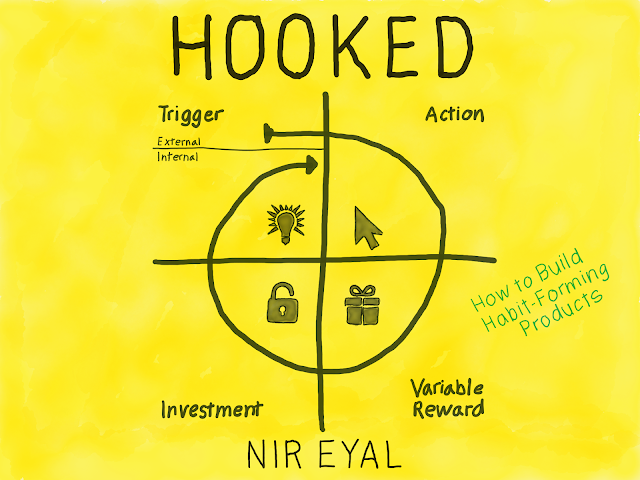
The book "Hooked," by Nir Eyal, applies psychology to website/app design to explain how successful products create unprompted user engagement - aka habits - where users visit a website/app repeatedly on their own.


(I'll simply use "app" from now on for "website/app.")


If you find that you regularly open an app - like FacebookYoutube, or Email - out of habit, that app has successfully "hooked" you. Why does that happen? If you're creating a product to be regularly used or want to use an app less, this book will help you.


Eyal identified a 4-step process, called the Hooked Model, that apps use to encourage users to repeatedly return. The book describes each step and why they work. I enjoy books that explain behavior with psychology. Plus, I'm building a website, so I was interested in seeing what parts I could incorporate.


It also helped me see when other apps use the Hooked Model. For example, I use a journaling app called Day One, and they do all of these steps, which has helped me journal regularly. It also explains why some apps, like Duolingo, feel pushy (I go on a mini-rant in the summary section).


One of Eyal's suggestions I'll use right away is to not just look at how people use my website (through usability testing). But to also create a user narrative that clearly describes the person's desires, emotions, and context when they start using the website. And it's not just making it up on my own, but using good, ol' fashion marketing research where you interview people, asking "why" at least 5 times to get to an emotional motivation.


Again, I highly recommend the book to anyone building an app.


The rest of this post contains my notes and quotes from the book. I recommend reading/listening to the book first and using the summary below for future reference. Or, read below as a teaser to see if you'd like it.


Saturday, January 15, 2022

"Don't Make Me Think" - Book Review and Summary


I recently finished reading "Don't Make Me Think" by Steve Krug. If I'm honest, this is just as much a reference for myself as sharing what I learned with you. The lessons are great and highly practical for anyone building a website. Krug works on the usability of websites - how easy a website is for a person to use - and goes deep on making it usable.


The Big Idea

Krug's first law of useability is: "Don't make me think." This means that "a Web page should be self-evident. Obvious. Self-explanatory" (p. 11). For example, "As a user, I should never have to devote a millisecond of thought to whether things are clickable—or not" (p. 15).


Reducing thinking is crucial because we don't read pages; we scan them. So you have to treat your page like a billboard on a freeway. As someone who likes to write long blog posts, that's a tough pill to swallow. But "If your audience is going to act like you're designing billboards, then design great billboards" (p. 27).


It's also important because users don't make optimal choices; we "satisfice" by choosing the first reasonable option. So, if you want a user to do something, it has to be at the top of the page and prominent.


How to Reduce Thinking

Krug gives some good ideas on making a page more obvious.


Take advantage of conventions

Links should look like links, and buttons should look like buttons, etc.

"If you're not going to use an existing Web convention, you need to be sure that what you're replacing it with either (a) is so clear and self-explanatory that there's no learning curve—so it's as good as the convention, or (b) adds so much value that it's worth a small learning curve. My recommendation: Innovate when you know you have a better idea, but take advantage of conventions when you don't" (p. 32).


This is also important for forms. The necessary part is collecting the information, not how cool it looks. Using conventional web forms helps users focus on the answers, and it also builds trust, which is required for someone to fill out a form accurately.


Create effective visual hierarchies

"A good visual hierarchy saves us work by preprocessing the page for us, organizing and prioritizing its contents in a way that we can grasp almost instantly" (p. 35).


These include big titles, noticeable subtitles, sections, and navigation.


Make it obvious what's clickable 

Krug keeps hammering this throughout the book.

"In general, you'll be fine if you just stick to one color for all text links or make sure that their shape and location identify them as clickable. Just don't make silly mistakes like using the same color for links and nonclickable headings" (p. 38).


Omit Needless Words

You want to format your content to support scanning. Remember, treat it like a billboard.


"In general, you'll want to use more headings than you'd think and put more time into writing them" (p. 39). And keep paragraphs short, use bulleted lists, and highlight key terms.


"Get rid of half the words on each page, then get rid of half of what's left" (p. 49). The advice is purposely excessive. In his experience, eliminating half the words on a page is easy. Reducing it further requires you truly understand visitors' minds and see the page through their scanning eyes.


Here's an example of eliminating words:

"Your objective should always be to eliminate instructions entirely by making everything self-explanatory, or as close to it as possible. When instructions are absolutely necessary, cut them back to the bare minimum" (p. 51).


Create Context With Well Designed Navigation

One problem with websites is that there's no physical sense of space. In a store, you have signs and can physically see what's next to each other. You can quickly find food vs. clothing vs. tools. And it's reasonably straightforward to drill down another level: freezer vs. cereal vs. drinks vs. etc.


However, you don't have that same sense of direction, location, or scale with websites. So to overcome it, you want straightforward navigation.


Krug goes deep into this area:

  • The logo should be upper right.
  • Utility placement (sign in, help, site map, shopping cart, etc.).
  • The role of search vs. menus (you want both).


Visit some bigger websites, and you'll quickly notice the conventions. Krug does have one note of warning:


"I think this is one of the most common problems in Web design (especially in larger sites): failing to give the lower-level navigation the same attention as the top. In so many sites, as soon as you get past the second level, the navigation breaks down and becomes ad hoc" (p. 73).


To overcome this problem: "It's vital to have sample pages that show the navigation for all the potential levels of the site before you start arguing about the color scheme" (p. 73). 


The following insight took me by surprise:


"Designers sometimes think, "Well, we've highlighted the page name in the navigation. That's good enough." It's a tempting idea because it can save space, and it's one less element to work into the page layout, but it's not enough. You need a page name, too." (p. 75).


So you do need to omit needless words, but page titles aren't one of them.


Finally, breadcrumbs are a form of "you are here" signs. They help create context in addition to helping you navigate. This is especially important if your website goes more than a couple of layers deep.


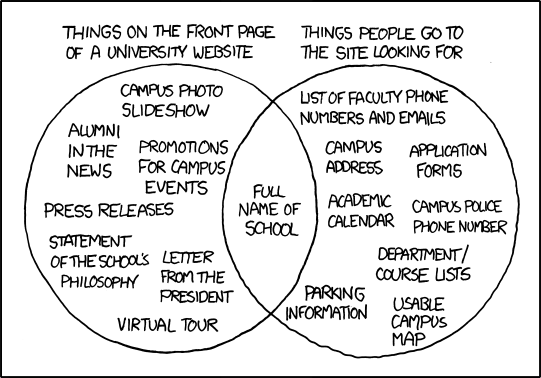
Create a Homepage For Your Visitors, Not For Yourself

Krug shares this amazing XKCD comic, which is so true it hurts.


Krug gets into the fine details of making a homepage: Where to put a tagline, how much of a welcome blub to use, and the proper use of "learn more."


"Don't feel compelled to mention every great feature, just a few of the most important ones" (p. 94).


This is another huge theme as well:

"[The Home page is] one of the most important things to test. You can't trust your own judgment about this. You need to show the Home page to people from outside your organization to tell you whether the design is getting this job done because the "main point" is the one thing nobody inside the organization will notice is missing" (p. 95).


Usability Testing Is Your Friend and Doesn't Need to Cost a Lot

Great design is complicated because there's no one correct answer. "All web users are unique and all web use is basically idiosyncratic" (p. 108)


"The point is, it's not productive to ask questions like "Do most people like pull-down menus?" The right kind of question to ask is, "Does this pull-down, with these items and this wording in this context on this page create a good experience for most people who are likely to use this site?" And there's really only one way to answer that kind of question: testing" (p. 109). 


Some of Krug's thoughts on testing:

  • If you want a great site, you need to test it.
  • Testing one user is 100% better than testing none.
  • Testing 1 user early in the project is better than testing 50 near the end.


And this doesn't have to be rocket science: "If you want to know whether something is easy enough to use, watch some people while they try to use it and note where they run into problems" (p. 115).


How Often Should You Test?

One morning a month.


You can test three users for an hour each, then debrief over lunch. The important part is to create a fixed schedule and stick with it.


How Many Users Do You Need?

"I think the ideal number of participants for each round of do-it-yourself testing is three" (p. 119).


The goal isn't to prove a point of view, but to give you actionable insights. And it's not to uncover every single problem. "You can find more problems in half a day than you can fix in a month... It's much more important to do more rounds of testing than to wring everything you can out of each round" (p. 119).


How Do You Choose Participants?

Interestingly, you don't want just domain knowledge experts. You want to cast a broad net - even people who know nothing about your industry. I liked this insight: "If 'almost anybody' can use it, your experts will be able to use it, too" (p. 121). It makes sense, but I'll admit that I didn't start there. After all, everyone starts as a beginner at some point, and you want them also to use your website.


How Do You Find Participants?

The usual places: Craigslist, Facebook, Twitter, customer forums, friends, and neighbors. A 1-hour session seems to be in the $50-$100 range. So, for $300 a month, you can get regular feedback on your website.


Where Do You Test?

You can do it in person or over Zoom. You do want to record the session so others can watch it. At Majordomo, we started with in-person testing and then switched to Zoom (with the rest of the world), and it seemed fine. It also made it easier to record since they shared their screen, and we hit the record button on our side.


What Do You Test?

It's never too early to start. Even if all you have is an idea, you can begin testing. For example, start with competitive websites to get a feel for what people like and dislike. Then move on to rough sketches, wireframes, prototypes, and finally actual pages.


The test itself is simple: get to know them (~10 minutes) and give them a set of tasks to complete (~35 minutes). For non-working pages, testers can point their fingers and explain what they would do.


Make sure the instructions are clear. Your job is to keep them focused and encourage them to think aloud.


"Don't ask them leading questions, and don't give them any clues or assistance unless they're hopelessly stuck or extremely frustrated. If they ask for help, just say something like 'What would you do if I wasn't here?' " (p. 126). 


Krug provides an example session in the book to see exactly how to run a test.


Deciding What To Fix

Focus on the most serious problem first. I liked this advice: "You don't have to fix each problem perfectly or completely. You just have to do something—often just a tweak—that will take it out of the category of 'serious problem' " (p. 138).


I also liked this advice:

"Resist the impulse to add things. When it's obvious in testing that users aren't getting something, the team's first reaction is usually to add something, like an explanation or some instructions. But very often the right solution is to take something (or some things) away that are obscuring the meaning, rather than adding yet another distraction" (p. 139).


"I tell people to ignore all comments that users make about colors during a user test, unless three out of four people use a word like "puke" to describe the color scheme. Then it's worth rethinking" (p. 169).


Final Advice Roundup

Krug finishes the book with a smattering of helpful advice:


  • "Know the main things that people want to do on your site and make them obvious and easy" (p. 170).
  • "Be upfront about things like shipping costs, hotel daily parking fees, service outages—anything you'd rather not be upfront about" (p. 170).
  • "Save me steps wherever you can" (p. 170). This is a massive advantage of the web over physical equivalents. Where can you use automation/prediction to make things easier?
  • Include candid FAQs, not Questions We Wish People Would Ask.
  • "Make it easy to recover from errors" (p. 171) because they will happen. Though, testing will help you eliminate the big ones.
  • Apologize: "If you can't do what they want, at least let them know that you know you're inconveniencing them" (p. 171).


Recommendation

That was a bit of a firehose, but it's all good! If you're doing any website or app development or design, I'll go as far as to say this is required reading. It's highly practical advice from someone in the trenches. It's not about creating something perfect or going through an official design process. It feels human and reasonable.


If all you do is follow his usability advice, you'll be in a much better place. If you invest in regular usability testing, you'll create a great website or app.